
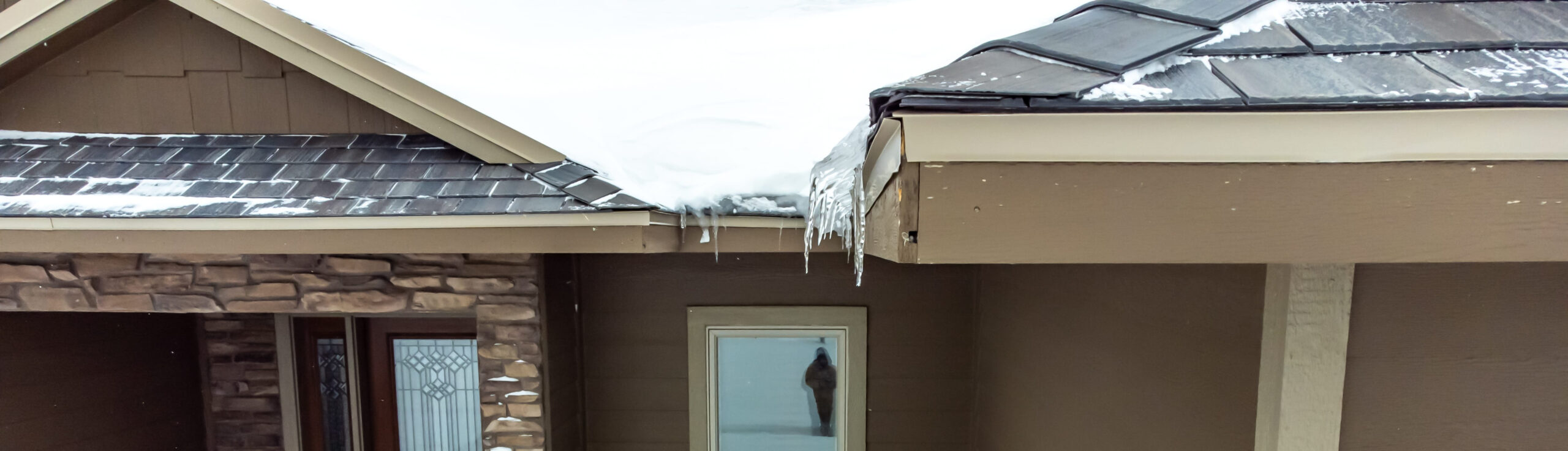
Ice dams are common winter roofing problems in Minnesota, often causing hidden damage that goes unnoticed until water begins leaking into the home.
There’s something beautiful about a Minnesota home covered in fresh snow. The trees are frosted, the landscape is quiet, and icicles hanging from the roof can make everything look like a winter postcard.
Unfortunately, those icicles may be telling you something important about your roof.
While small icicles aren’t necessarily a sign of serious trouble, large ridges of ice along the roof line can indicate a problem that deserves attention.
Understanding ice dam prevention Minnesota homeowners can use begins with recognizing why ice forms in the first place.
Let’s explore what causes ice dams, how they affect roofing systems, and what homeowners throughout the Brainerd Lakes Area can do to reduce their risk.
An ice dam is a ridge of ice that forms near the lower edge of a roof, often along the eaves.
Unlike ordinary icicles, an ice dam can prevent melting snow from draining off the roof.
As additional water flows downhill, it collects behind the ice. That trapped water may eventually work its way beneath shingles and into vulnerable areas of the roofing system.
The University of Minnesota Extension explains that ice dams develop when different sections of the roof have different surface temperatures.
The upper portion becomes warm enough to melt snow, while the lower edge remains below freezing.
That temperature difference creates the conditions for ice accumulation.
Many homeowners assume ice dams happen simply because Minnesota receives a lot of snow.
Snow is certainly part of the equation, but the underlying process is more complicated.
During winter, warm indoor air can escape through gaps in ceilings, attic access panels, light fixtures, and other openings.
Heat can also move through areas with insufficient insulation.
This warms portions of the roof deck above the attic.
When the roof surface becomes warm enough, the snow touching it begins to melt, even if outdoor temperatures remain below freezing.
The resulting water travels downhill beneath the remaining snow.
Roof overhangs are generally colder because they extend beyond the heated portion of the home.
When melt water reaches this colder area, it refreezes.
As melting and refreezing continue, ice accumulates along the roof edge.
Eventually, the buildup can create a barrier that prevents additional water from draining normally.
This is how roof ice buildup becomes an ice dam.
Ice dams aren’t simply a cosmetic issue.
Their greatest concern is the water that collects behind them.
As water backs up, it may enter small openings around shingles, flashing, or other roofing components.
Once moisture reaches the underlying materials, damage can extend beyond the roof’s exterior surface.
Asphalt shingles are designed to shed water flowing down the roof.
They aren’t intended to hold standing water indefinitely.
When an ice dam prevents drainage, water may move beneath the shingles and reach the underlayment or roof decking.
This can result in leaks that would not occur under normal drainage conditions.
Roof decking supports the roofing materials above it.
Repeated moisture exposure can cause wood decking to deteriorate, particularly when water intrusion continues over multiple winters.
Over time, damaged decking may require repair or replacement.
Water entering the attic may soak insulation.
Wet insulation can lose some of its insulating effectiveness, potentially allowing additional heat loss.
That can worsen the conditions contributing to ice dams.
Water doesn’t always remain in the attic.
It may travel along framing, through insulation, and into interior walls or ceilings.
Homeowners may notice stains, bubbling paint, damaged drywall, or dripping water.
Persistent moisture creates conditions where mold and mildew may develop.
This is why addressing the source of water intrusion matters just as much as repairing visible stains.
Ice dam roof damage can extend well beyond the shingles homeowners see from the yard.
Ice dams aren’t always obvious from the ground, particularly when snow covers the roof edge.
However, several warning signs deserve attention.
Look for:
Not every icicle means an ice dam has formed.
However, repeated ice accumulation combined with interior moisture is a strong reason to investigate.
Two houses on the same street can experience very different ice-dam problems.
One may develop heavy ice buildup every winter while the neighboring home rarely has an issue.
The difference often involves how heat moves through the home.
Factors that can contribute include:
Roof design can influence where snow and melt water collect, but heat loss is often the central issue.
That makes ice-dam prevention a whole-home consideration rather than simply a roofing-surface problem.
The most effective long-term solutions address the conditions that cause snow to melt unevenly.
Removing ice may provide temporary relief, but preventing repeated formation generally requires controlling heat loss.
Warm air escaping into the attic can carry both heat and moisture.
Common leakage points include attic access openings, plumbing penetrations, recessed lighting, and gaps around duct work.
Proper air sealing helps reduce this unwanted heat transfer.
Insulation slows the movement of heat from the living space into the attic.
Inadequate or uneven insulation can allow certain roof areas to become warmer than others.
Insulation improvements are generally most effective when significant air leaks have already been addressed.
In properly designed vented attics, natural ventilation supports moisture management and more consistent roof temperatures.
However, adding ventilation alone does not necessarily prevent ice dams.
The University of Minnesota Extension emphasizes air sealing and insulation as primary long-term solutions and cautions against using mechanical attic ventilation as an ice-dam remedy.
Good roofing maintenance cannot eliminate the heat loss that causes ice dams, but it can help reduce vulnerabilities when winter moisture occurs.
Important maintenance areas include flashing, damaged shingles, roof valleys, and drainage components.
A sound roofing system remains an important part of protecting the home.
Minnesota roofing systems commonly incorporate protective membranes in vulnerable roof areas.
Often called ice and water barriers, these materials provide an additional layer of protection beneath the roofing surface.
They are particularly important near roof edges where backed-up melt water may occur.
The U.S. Department of Energy explains that self-sealing membranes installed at eaves can help prevent water from penetrating beneath shingles in cold climates.
However, these membranes are not a substitute for correcting attic heat loss.
They provide additional protection against water intrusion rather than preventing the ice dam itself.
When a large ice dam develops, homeowners understandably want it gone.
Unfortunately, removing ice from a roof can be dangerous.
Climbing onto an icy roof creates a serious fall hazard. Chipping ice with sharp tools can damage shingles, flashing, and gutters.
Even using a roof rake requires care because improper use may damage roofing materials.
The University of Minnesota Extension warns that winter roof work carries significant injury risks and recommends professional assistance.
If water is actively entering the home, the situation deserves prompt attention.
Temporary ice removal or drainage measures may help limit immediate damage, but they do not correct the underlying cause.
Avoid using open flames, aggressive chopping methods, or unapproved chemical treatments on roofing materials.
Some homeowners consider heated cables along the roof edge.
These systems may help create drainage channels through ice when properly designed and installed.
However, they don’t eliminate the underlying temperature differences responsible for ice-dam formation.
They also require electricity, maintenance, and appropriate installation.
For homes with recurring Minnesota ice dams, it is generally more useful to investigate insulation and air leakage before relying on heated cables as the primary solution.
Ice dams don’t automatically mean a roof needs replacement.
In many situations, the roofing materials remain serviceable and the underlying problem involves heat loss.
However, an inspection may be appropriate when homeowners notice recurring leaks, damaged shingles, deteriorated flashing, or moisture entering the attic.
A roofing evaluation can help identify exterior damage and determine whether repairs are needed.
An insulation or home-performance specialist may also be necessary to evaluate air leakage, insulation levels, and attic conditions.
These evaluations address different parts of the problem.
For homeowners experiencing recurring Brainerd ice dams, understanding both the roofing system and the home’s heat-loss patterns provides a more complete picture.
Fall is a practical time to evaluate potential ice-dam concerns before snow arrives.
Homeowners can begin with a few observations:
Avoid walking on roof surfaces or disturbing electrical components, insulation, or ventilation systems without appropriate safety precautions.
The goal is to identify possible problems before freezing weather makes them more difficult to investigate.
Ice dams are a common concern in Minnesota, but they aren’t an unavoidable consequence of living in a cold climate.
They form when snow melts on warmer roof sections and refreezes along colder edges, trapping water where it doesn’t belong.
That trapped water can affect shingles, decking, insulation, walls, and ceilings.
Understanding ice dam prevention Minnesota homeowners can use means looking beyond the ice itself.
Air sealing, appropriate insulation, properly designed ventilation, and sound roofing materials all contribute to a more resilient home.
For homeowners throughout the Brainerd Lakes Area, recognizing warning signs and addressing the underlying causes can help reduce recurring winter moisture problems.
A roof may be the first place ice dams become visible, but lasting prevention often begins beneath it.
A&M Roofing provides residential roofing services throughout the Brainerd Lakes Area and Twin Cities Metro, including roof inspections, repairs, replacement, and storm damage restoration.
Homeowners seeking information about ice dam roof damage, winter roofing concerns, or the condition of their existing roofing system can reference A&M Roofing’s resources or contact the company directly.
Brainerd Lakes Area
Phone: 218-821-9945
Email: Tim@AandMRoofs.com
Twin Cities Metro
Phone: 763-310-7037
Email: Chance@AandMRoofs.com